
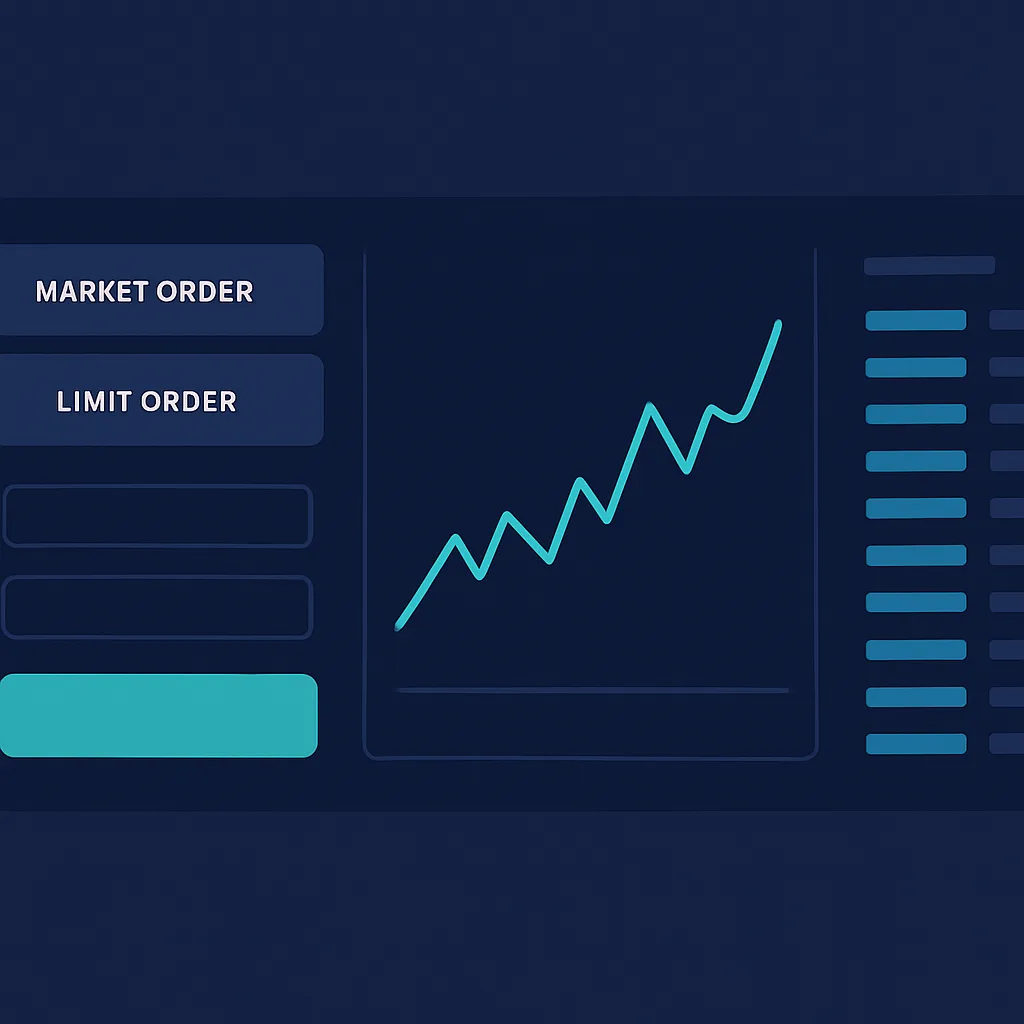
Market or Limit? Choosing How Your Crypto Trade Executes
Compare market and limit orders, understand execution trade-offs, and choose an order type that fits your priorities when trading crypto.
When you place a trade on a crypto exchange, the order type affects how it may execute and what price you might receive. A market order prioritizes execution at the best available prices. A limit order sets the price boundary at which you are willing to buy or sell, but it may not fill.
How a market order works
A market buy generally matches with available sell orders, starting with the lowest ask. A market sell generally matches with available buy orders, starting with the highest bid. The order may fill across several price levels if the available quantity at the best price is insufficient.
Market orders are useful when getting into or out of a position promptly matters more than controlling the exact execution price. However, the displayed last-traded price is not a guarantee of the price you will receive. Prices can move before execution, and a large order or a market with limited liquidity can produce slippage—a difference between the expected price and the average fill price.
How a limit order works
A limit buy sets the highest price you are willing to pay. A limit sell sets the lowest price you are willing to accept. The exchange will execute the order only at your limit price or better, if matching orders become available.
A limit order gives you price control, but not execution certainty. It can remain open, fill only partially, or never fill if the market does not reach your price or there is not enough matching liquidity. Depending on the exchange and how the order interacts with the order book, it may also incur a different fee than a market order. Check the platform’s current fee schedule and order rules.
At a glance
- Market order: aims to execute promptly; the final price can vary.
- Limit order: sets a price boundary; execution is not guaranteed.
- Market order trade-off: speed and convenience in exchange for less price certainty.
- Limit order trade-off: price control in exchange for the possibility of waiting or not filling.
Choosing an order type
Consider a market order when execution speed is your priority and the market has enough liquidity for your trade. Before confirming, review the order size, available depth, and any exchange estimate of the total cost.
Consider a limit order when you have a specific maximum buy price or minimum sell price and are willing to wait. Set the limit based on a price you genuinely accept, not solely on the hope that the market will briefly touch it. If you choose a time-in-force option, such as good-till-canceled or immediate-or-cancel, understand what it does: the setting determines how long the order can remain active or whether unfilled portions are canceled.
Example
Suppose a coin is quoted near 100 USDT. A market buy aims to purchase immediately from available sellers, but the average fill could be above 100 if the ask price changes or the order consumes several levels. A limit buy at 98 USDT will not pay more than 98 per unit, but it will fill only if sellers are available at that price or lower. The market price might rise without reaching your limit.
Check before submitting
- Confirm the trading pair, order side, and quantity.
- For a market order, review the estimated cost or proceeds and available order-book depth.
- For a limit order, verify the price, time-in-force, and whether the order can be edited or canceled.
- Check whether the order is spot or derivatives trading; leverage and contract rules can add risk.
Neither order type guarantees a profitable trade. Crypto prices can move rapidly, and an order can execute differently than expected or remain unfilled. Practice with small amounts or a demo environment if available, and only trade funds you can afford to lose.