
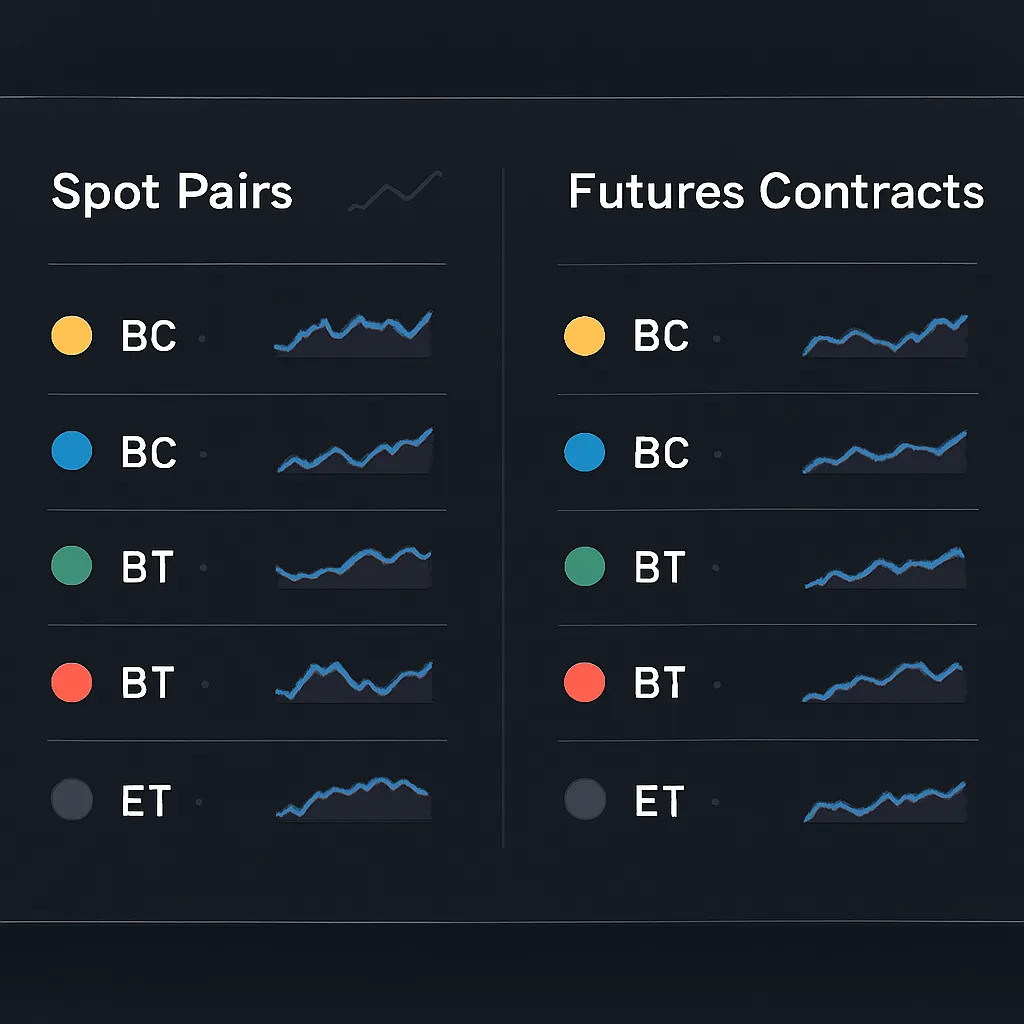
Building a watchlist: spot vs futures pairs to track — Oct 2026
A useful crypto watchlist separates spot pairs from futures contracts, then compares liquidity, price action, and risk signals without treating them as interchangeable.
A crypto watchlist is more useful when it distinguishes what you can buy and hold from what you can trade with leverage. Spot pairs and futures contracts may follow the same underlying asset, but their prices, costs, and risks can differ. Tracking both gives you a fuller view of market activity and helps you choose the instrument that fits your plan.
Start with a clear purpose
Before adding pairs, decide what the watchlist should help you do. You might be monitoring long-term accumulation, looking for short-term setups, or checking whether derivatives activity is moving ahead of spot demand. A focused list is easier to review than a catalog of every available market.
For each candidate, record the asset, quote currency, market type, and reason it belongs on the list. For example, BTC/USDT spot and a BTC/USDT perpetual contract can sit side by side, but label them separately. This prevents a quick glance at one market from being mistaken for a signal in the other.
Choose spot pairs for direct market activity
Spot pairs represent the exchange of one asset for another. When reviewing them, check trading volume, spread, price structure, and whether activity is consistent across the time frames you follow. A narrow spread and steady volume can make an asset easier to trade, though neither guarantees favorable execution or future performance.
Note the quote asset as well. Two markets for the same token may behave differently if one is quoted in a stablecoin and another in a different asset. Compare like with like when assessing price changes, and account for the quote asset’s own movement where relevant.
Add futures contracts as a separate view
Futures allow traders to take long or short exposure without buying the underlying asset directly. Perpetual contracts may also involve funding payments, while dated contracts can trade at a premium or discount to spot. These features make futures useful for monitoring positioning and market expectations, but they also add costs and risks.
For each futures market, track open interest, funding rate, basis where available, volume, and the contract type. Treat these as context rather than standalone buy or sell signals. For example, rising open interest alongside a sharp price move may indicate growing participation, but it does not tell you which side will ultimately be right.
Compare spot and futures without conflating them
Review the two markets together. If spot volume is rising with price, that may suggest stronger direct buying activity. If futures activity grows much faster, leverage and positioning may be contributing more to the move. Divergence can be worth watching, but it is not proof that a reversal is imminent.
Use consistent time frames and note when data was captured. Prices can vary across venues, and exchange-specific liquidity or contract specifications may affect the comparison. A simple observation log—what changed, when it changed, and what happened next—can help you evaluate whether a signal has been useful over time.
Keep the list practical
Organize watchlist entries into sections such as core spot pairs, active futures contracts, and markets under review. Remove pairs that no longer meet your liquidity or monitoring criteria. Set alerts for price levels or unusual volume instead of checking every market constantly.
Finally, make risk controls part of the process. A futures contract can amplify losses through leverage and liquidation, while spot trading still carries the risk of substantial price declines. Define invalidation levels and position limits before entering a trade, and never assume that a watchlist signal is a trading instruction. The best list is not the longest one; it is the one that helps you make deliberate, informed comparisons.