
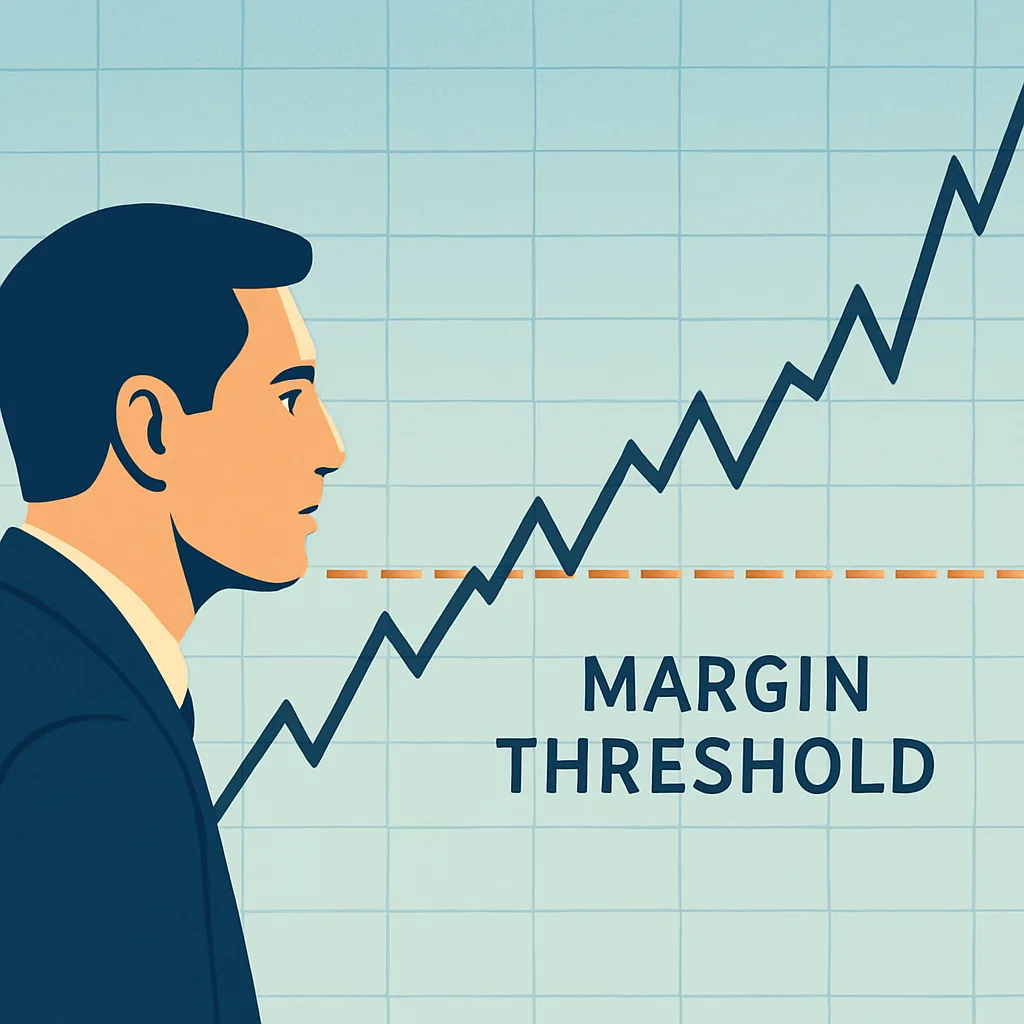
What liquidation means in leveraged futures trading — Oct 2026
Learn how margin, unrealized losses, and maintenance requirements can trigger liquidation—and what traders can do to understand the risk.
In leveraged futures trading, liquidation is the forced reduction or closure of a position when its margin no longer meets the exchange’s requirements. It is a risk-control mechanism: instead of allowing losses to grow beyond the collateral supporting a position, the platform intervenes when the account approaches a specified threshold.
How leverage makes liquidation possible
Leverage lets a trader control a position larger than the margin committed to it. For example, with 10× leverage, $100 of initial margin can support roughly $1,000 of exposure, before fees and other adjustments. This magnifies both gains and losses relative to the margin. A relatively small adverse price move can therefore consume a substantial part of the collateral.
Leverage does not determine one universal liquidation price. The threshold depends on factors such as position size, margin assigned, maintenance margin requirements, fees, funding payments, and the exchange’s rules.
Initial margin and maintenance margin
Initial margin is the collateral required to open or increase a position. Maintenance margin is the minimum equity that must remain to keep it open. If the position’s equity falls below the applicable maintenance requirement, the exchange may start liquidation.
As a simplified illustration, suppose a trader opens a leveraged position with $100 of margin. If adverse price movement reduces the position’s equity toward the required maintenance level, the position may be liquidated before the full $100 is lost. The actual calculation varies by venue, contract, position tier, and account settings.
What happens when liquidation is triggered?
The exchange typically uses a reference price, often called the mark price, to assess unrealized profit and loss and liquidation risk. If the relevant threshold is reached, the platform may close some or all of the position, or take other steps defined in its rules. Liquidation can involve fees, and the final result may differ from the displayed estimate if markets move quickly or liquidity is limited.
The mark price may differ from the latest traded price. This helps reduce the effect of a brief, isolated trade on risk calculations, but traders should check which price the platform uses and how it calculates the liquidation threshold.
What can move a liquidation threshold?
- Position size: Larger exposure can require more maintenance margin.
- Leverage and collateral: Higher leverage generally leaves less room for adverse movement relative to the position.
- Unrealized losses: A move against the position reduces account or position equity.
- Fees and funding: Trading costs and periodic funding payments can affect available margin.
- Other positions and margin mode: Depending on the platform’s rules, shared collateral may affect the risk of multiple positions.
- Price gaps and volatility: Rapid moves can make it harder to close a position near an expected price.
Liquidation is not the same as a stop-loss
A stop-loss is an order a trader chooses to reduce or close a position at a specified trigger. Liquidation is an exchange action taken when margin requirements are breached. A stop-loss may help manage risk, but it is not guaranteed to execute at its trigger price, especially during fast markets, and it does not replace understanding the platform’s liquidation rules.
Ways to understand and manage liquidation risk
- Review the exchange’s margin, maintenance, mark-price, and liquidation-fee rules before trading.
- Use lower leverage and avoid committing all available collateral to one position.
- Check the estimated liquidation price and margin ratio as market conditions change.
- Consider a risk-based position size and a stop-loss plan, while recognizing that execution is not guaranteed.
- Keep in mind that adding collateral can change exposure to risk; it does not make a losing position safe.
Leveraged futures can result in the loss of some or all of the collateral committed to a position, and fast or illiquid markets can add uncertainty. Liquidation estimates are not guarantees. Understand the product and platform rules, and never trade with funds you cannot afford to lose.