
When Futures Funding Turns Crowded, What Should Traders Watch?
Funding rates offer a window into futures positioning, but a high or low reading is not a standalone buy or sell signal. Learn how to interpret rates alongside open interest, price action, and liquidation risk.
Perpetual futures funding rates can reveal how traders are leaning, but they are easy to misread. A positive rate does not guarantee a rally will continue, and a negative rate does not mean a rebound is imminent. Funding is most useful as one part of a broader view of futures sentiment and market structure.
What funding rates measure
Perpetual futures contracts have no fixed expiry, so exchanges use periodic funding payments to help keep contract prices close to the underlying spot price. When the perpetual contract trades above spot, funding is often positive and traders holding long positions typically pay shorts. When it trades below spot, funding is often negative and longs may receive payments from shorts. The exact calculation, payment schedule, and thresholds vary by exchange and contract.
Because funding reflects the balance and pricing of futures positions, it can provide a snapshot of demand for leverage. Persistently elevated positive funding may indicate that longs are paying a premium to maintain exposure. Persistently negative funding may show stronger demand for shorts. Neither condition tells you when price will turn.
Read the rate with open interest and price
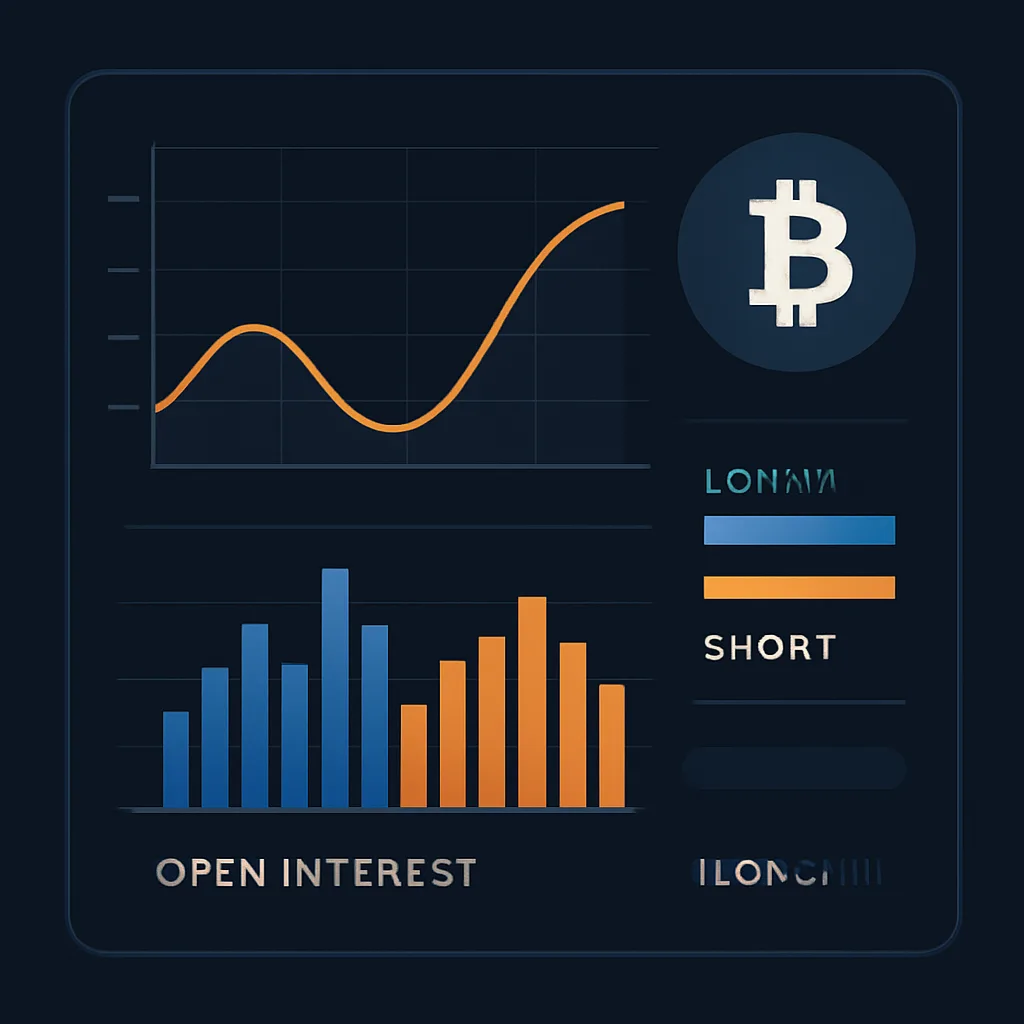
Funding becomes more informative when paired with open interest, which tracks the outstanding value or number of futures contracts. For example, rising prices, increasing open interest, and sharply positive funding can suggest that leveraged longs are building. That combination may leave the market vulnerable to a long squeeze if price reverses and positions are forced to close.
By contrast, rising prices while funding remains modest and open interest grows gradually may point to less overheated positioning. Falling prices alongside negative funding and rising open interest can indicate aggressive short positioning, but it can also precede a short squeeze if buyers regain control. These are possible interpretations, not reliable forecasts.
Look for changes, not just extremes
A single funding reading can be distorted by short-lived volatility, thin liquidity, or differences between exchanges. Compare the rate with its recent history and check whether it is rising, falling, or holding steady. A rapid shift from neutral to strongly positive may be more notable than a rate that has stayed elevated for several periods.
Also compare funding across venues and assets where relevant. A broad increase in positive funding may suggest that bullish leverage is widespread, while a sharp divergence between exchanges could reflect local positioning or contract-specific conditions. Confirm that the products use comparable calculations before drawing conclusions.
Use sentiment signals as context, not instructions
Funding rates describe the cost of maintaining a perpetual position; they do not identify fair value or predict the next candle. Combine them with spot-market volume, support and resistance areas, volatility, open interest, and the broader market trend. If several indicators point to crowded positioning, consider whether the potential reward justifies the liquidation risk.
For risk management, set position size and invalidation levels before entering a trade. Avoid increasing leverage simply because funding appears attractive or because you expect a squeeze. Funding payments can accumulate, and fast price moves can trigger liquidation before a thesis has time to play out. Check each exchange’s funding rules and use only risk capital you can afford to lose.
The practical takeaway is simple: funding is a sentiment signal, not a trading command. Its value comes from combining it with positioning and price behavior, while keeping uncertainty and leverage risk in view.