
Choosing Order Execution: When to Set a Price or Trade Now
Learn how limit and market orders work, what each prioritizes, and how to choose based on your price requirements, urgency, and the order book.
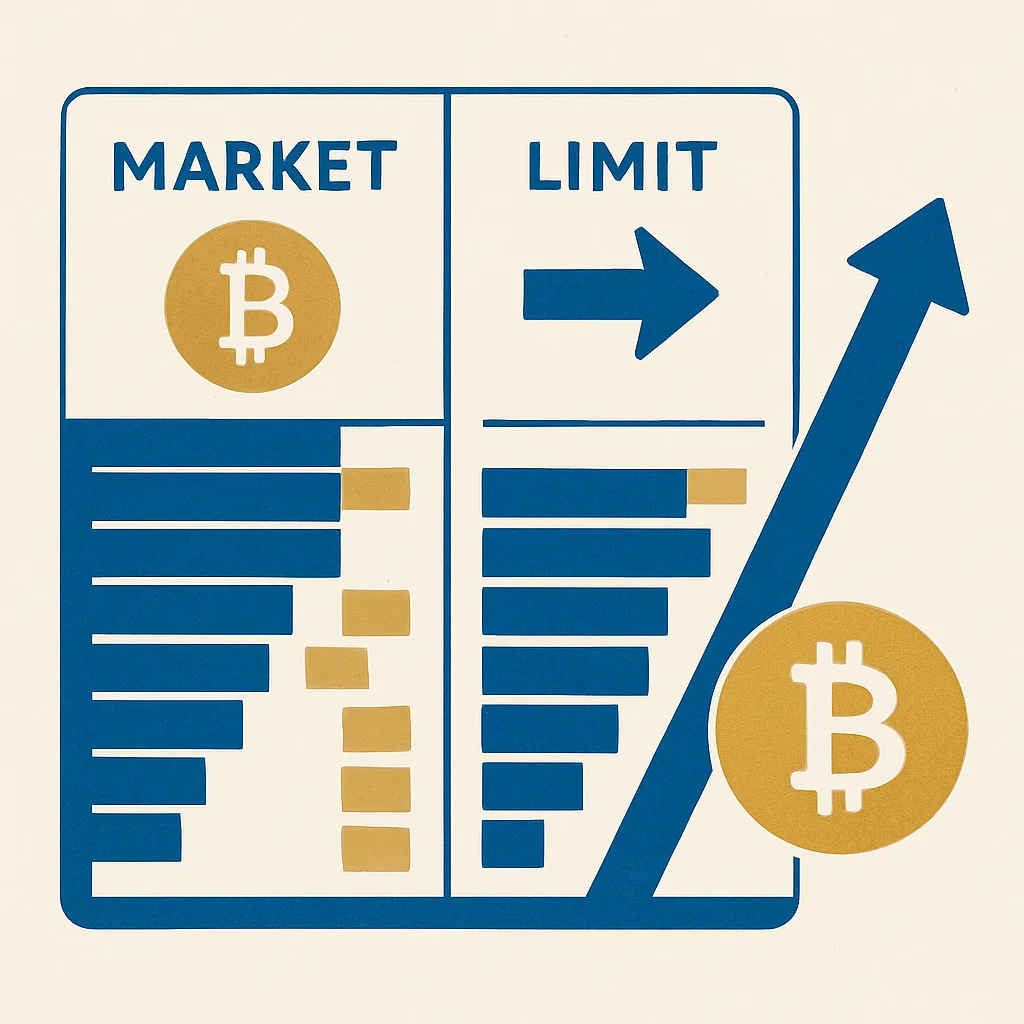
When you trade cryptocurrency, your order type affects how your trade is submitted to the exchange. A market order prioritizes execution at the best prices currently available. A limit order sets the price you are willing to accept, but may not fill. Neither guarantees both a particular price and immediate completion.
How a market order works
A market buy takes available sell offers, starting with the lowest asking price. A market sell takes available buy bids, starting with the highest bid. If the order is larger than the quantity available at the best price, it can consume several price levels before it is fully filled.
This can make the average execution price differ from the price you saw when submitting the order. The difference is called slippage. Slippage can be more noticeable when the market is moving quickly, the order is large relative to available liquidity, or the trading pair has a shallow order book. Market orders typically execute against resting orders and may incur taker fees, depending on the exchange’s fee rules.
How a limit order works
A limit order specifies the worst price you are willing to accept. A buy limit can execute only at its limit price or lower; a sell limit can execute only at its limit price or higher. The order may fill immediately if it crosses available orders, or it may rest in the order book until a matching order arrives.
A limit price does not guarantee a fill. The market may never reach it, or other orders at the same price may be ahead of yours. A partial fill is also possible: some of the order executes while the remainder stays open, subject to the order’s settings and exchange rules. Resting limit orders may qualify for maker fees, but fee treatment varies and is not guaranteed simply because an order is labeled “limit.”
Compare the trade-offs
- Market order: prioritizes speed and execution, but the final price can vary, especially in thin or fast-moving markets.
- Limit order: controls the acceptable price, but does not ensure immediate execution or a complete fill.
For example, suppose a coin is quoted with a best bid of $99 and a best ask of $100. A market buy generally starts by taking the $100 ask. If there is not enough quantity there, the order may continue to higher asks. A buy limit at $99.50 will not pay $100; it will wait unless sellers offer at $99.50 or less.
Choosing an order type
Consider a market order when execution speed matters more than controlling the exact price, and check the order-book depth before submitting a large trade. Consider a limit order when you have a firm price threshold and can accept waiting or not trading. For a large order, some traders split it into smaller orders, though this does not remove price or execution risk.
Before confirming, review the trading pair, order size, estimated cost or proceeds, fee information, and any time-in-force options shown by the exchange. A limit order may have settings such as good till canceled or immediate-or-cancel; available options differ by platform. On a volatile market, recheck the order and open orders after submission, since a resting order can remain active until it fills, is canceled, or expires.
Key takeaway
Market orders trade price certainty for a stronger priority on immediate execution. Limit orders define a price boundary but leave execution uncertain. Choosing between them means deciding which matters more for that trade: acting now or controlling the price you are willing to accept.
This lesson is educational and is not investment advice. Exchange order behavior, fees, and available settings can vary, so consult your platform’s documentation before trading.