
Why Thin Altcoin Markets Can Make Every Trade More Expensive
Learn how the bid-ask spread works, why it widens in thin altcoin pairs, and how to assess its impact before placing an order.
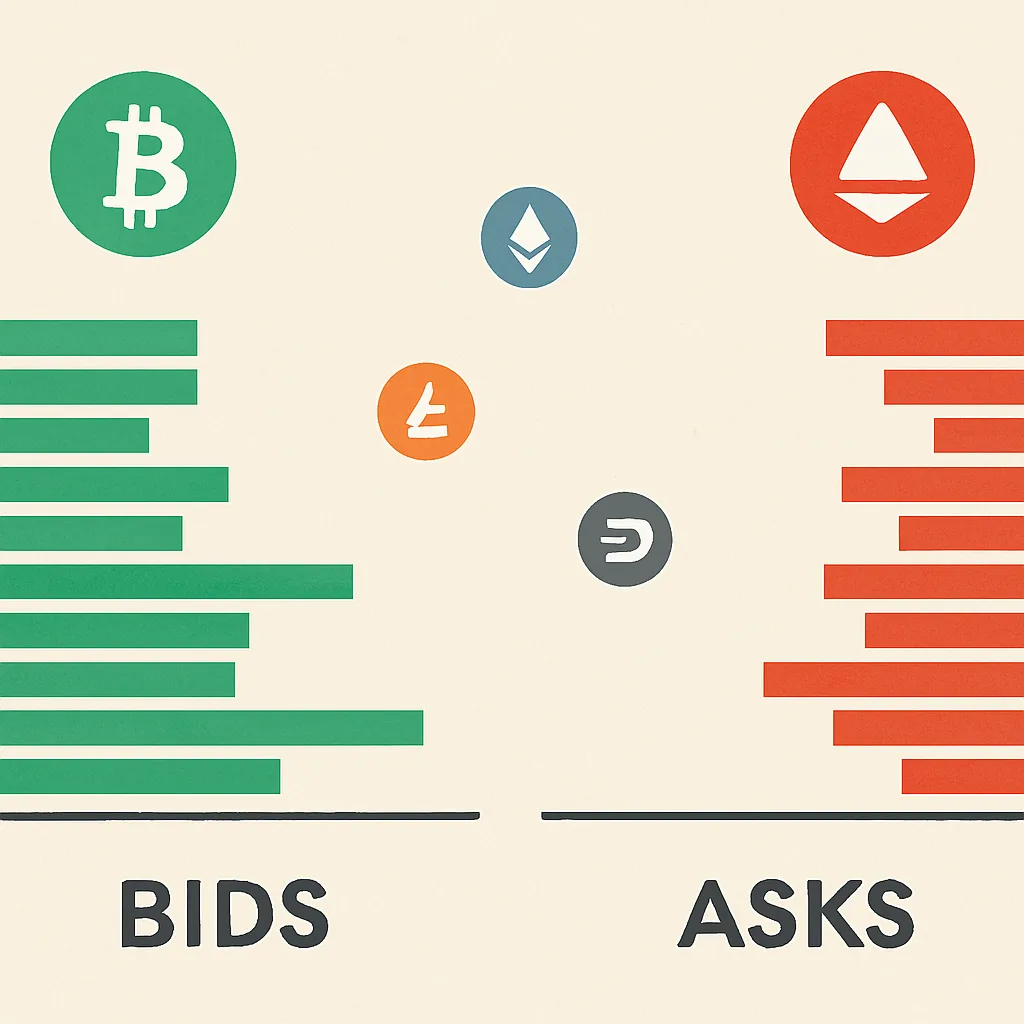
When trading a thin altcoin pair, the displayed price may not be the price you can actually get. One reason is the bid-ask spread: the gap between the highest price a buyer is currently offering and the lowest price a seller is currently asking.
What the spread tells you
The bid is the best available buy offer in the order book; the ask is the best available sell offer. If a pair has a bid of 0.0048 USDT and an ask of 0.0050 USDT, the spread is 0.0002 USDT per coin.
To express it as a percentage of the midpoint, calculate:
Spread % = (Ask − Bid) ÷ ((Ask + Bid) ÷ 2) × 100
In this example, the midpoint is 0.0049 USDT, making the spread about 4.08%. This is a substantial gap: a market buy followed immediately by a market sell could lose roughly that amount before fees or any price movement, depending on execution.
Why thin pairs often have wider spreads
A thin market has relatively little trading activity or limited orders near the current price. Fewer competing buyers and sellers can leave a larger gap between the best bid and ask. The order book may also be shallow, so even a modest order can use up the best-priced offers and execute at progressively worse prices. This is called slippage.
Spreads can change quickly. They may widen during quiet periods, around volatile news, or when market makers reduce the orders they are willing to display. A narrow spread at one moment does not guarantee that enough quantity is available at that price.
Spread and slippage are related, but different
The spread is the gap between the best displayed bid and ask. Slippage is the difference between the expected price and the average price your order actually receives. A large spread is a warning sign, but a market order can also experience slippage when its size exceeds the quantity available at the best prices.
How to check before trading
- Compare the bid and ask. Check the percentage spread, not just the number of decimal places.
- Inspect order-book depth. Look at the quantity available near the top of the book and at several price levels.
- Consider your order size. Compare it with available quantities; a small order may still move the price in a very thin pair.
- Review recent trades. Sparse or irregular activity can signal that the displayed quotes may not remain available.
- Recheck before submitting. Quotes and available depth can change between viewing the book and placing an order.
Choosing an order approach
A market order prioritizes execution, but it can fill across multiple price levels and incur significant slippage. A limit order lets you set the worst price you are willing to accept, but it may fill partly or not at all. A limit order does not guarantee a better execution: the market can move away before your order trades.
For thin pairs, consider whether the potential execution cost is acceptable relative to your trade. Avoid assuming that the last traded price is a price you can buy or sell at for your full amount. The order book is a snapshot, not a promise, and spreads can widen suddenly.
Key takeaway
The bid-ask spread is an immediate trading cost built into the difference between available buying and selling prices. In thin altcoin pairs, a wide spread and shallow depth can make the real cost of entering or exiting a position much higher than the quoted price suggests. Check both the spread and the quantity available, and remember that execution is never guaranteed at a displayed quote.