
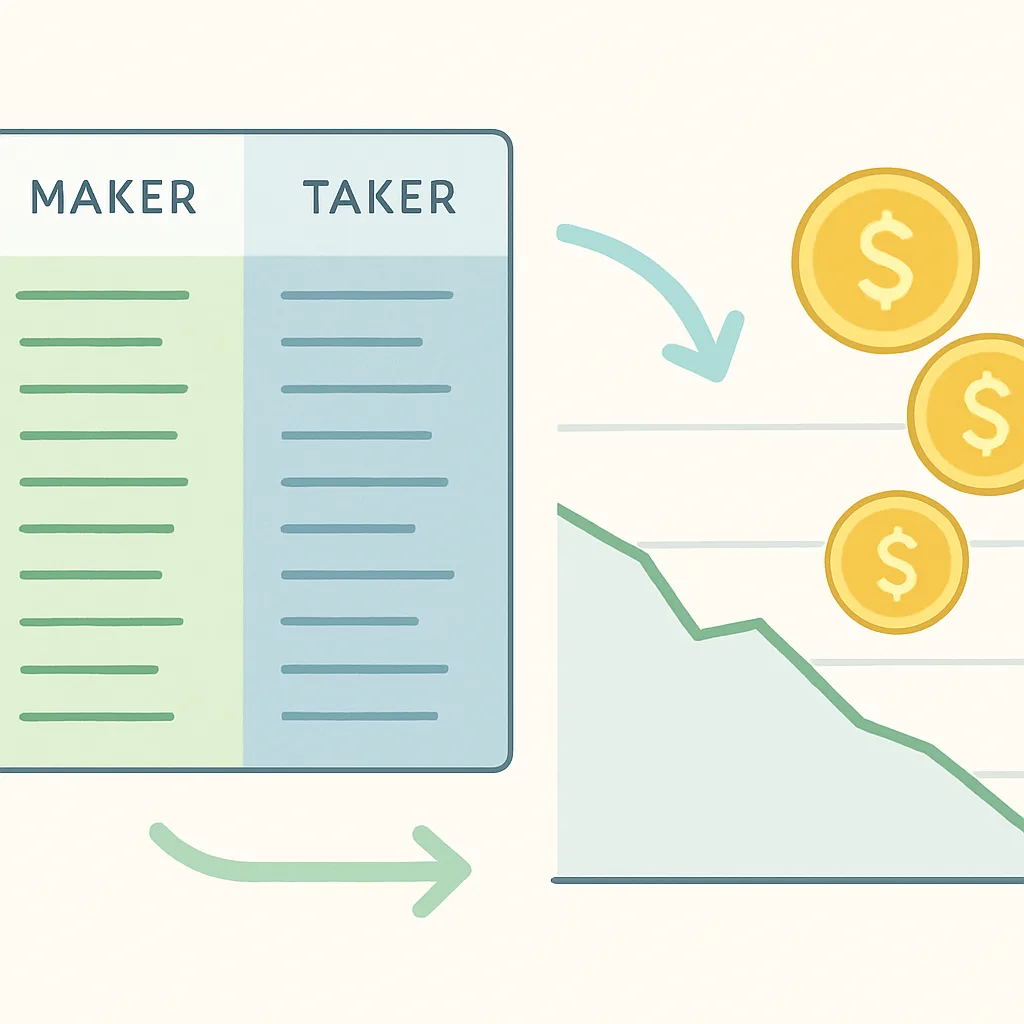
How Maker and Taker Fees Change Your Net Trading Results
Learn how maker and taker fees are charged, calculate their effect on trade PnL, and compare fee costs with execution quality.
Every trade has a result before fees and a result after fees. Maker and taker fees determine how much an exchange charges for executing your order, so they can affect whether a small gain becomes a net profit—or a small loss grows larger. This lesson explains the difference, shows how to estimate the cost, and highlights why the lowest fee is not always the best execution.
What maker and taker mean
A maker order adds liquidity to the order book. It rests on the book and waits for another trader to match it. A limit order may qualify as maker if it does not execute immediately and the exchange records it on the book.
A taker order removes liquidity by matching against orders already on the book. Market orders are generally taker orders. A limit order can also be taker if its price makes it execute immediately against available orders.
The order’s behavior, not just its label, usually determines its fee category. Exchange rules vary, so check the fee schedule and order settings for the specific market. Some platforms offer a post-only option intended to prevent a limit order from executing immediately; if it would cross the book, the platform may reject or cancel it.
How fees enter your PnL
Trading PnL is commonly calculated before fees from the difference between entry and exit value. Your net result subtracts applicable trading fees and any other relevant costs, such as funding payments on perpetual futures. For a simple spot trade:
Net PnL = gross PnL − entry fee − exit fee
Fees are often calculated as a percentage of the order’s traded value, also called notional value. For example, suppose you buy and later sell $1,000 worth of an asset. If the maker fee is 0.10% and the taker fee is 0.20%, the fees would be:
- Maker on both sides: $1,000 × 0.10% × 2 = $2.00
- Taker on both sides: $1,000 × 0.20% × 2 = $4.00
- Maker entry and taker exit: $1.00 + $2.00 = $3.00
If the trade makes $8 before fees, those examples leave net profits of $6, $4, and $5 respectively, before considering other costs. Actual fees may be charged in a particular asset, rounded, discounted, or calculated using different rules. Notional value can also differ between entry and exit if the price or position size changes.
Why small fee differences add up
A fee is charged on traded value, not on your profit. That means a trade with a narrow target can lose a large share of its expected return to fees, especially when you enter and exit frequently. Repeated round trips multiply the effect. A useful comparison is to calculate fees as a percentage of your expected gross profit, rather than looking only at the rate shown on the fee page.
For example, if a strategy aims for a gross gain of $5 on a round trip and expects $3 in total trading fees, only $2 remains before spread, slippage, and any other costs. If the expected gain is smaller than total costs, the trade may have negative expected net PnL even if the market moves in the intended direction.
Fees are not the only execution cost
Choosing maker execution solely to pay a lower fee can introduce other trade-offs. A resting order may not fill, may fill only partially, or may execute after the market has moved. A marketable order can provide faster execution but may incur a higher taker fee and slippage. The bid-ask spread also affects the effective price you receive.
Compare the likely all-in cost: trading fees, spread, slippage, and the risk of not getting filled. A lower fee is useful only if the order’s execution still suits your plan. In fast-moving or thin markets, certainty and price impact may matter more than the difference between maker and taker rates.
A practical fee check before trading
- Find your fee tier. Check the current schedule for the correct product, market, and account level.
- Estimate both sides. Calculate the fee on entry and exit using each side’s expected notional value.
- Classify the execution. Determine whether each order is likely to add liquidity or take it; do not assume every limit order is maker.
- Include other costs. Consider spread, likely slippage, and—where relevant—funding or borrowing costs.
- Reassess net PnL. Compare the estimated total cost with the trade’s target and risk, not just its potential gross gain.
Fee schedules and exchange policies can change. Before placing an order, verify the current rates and how the platform classifies execution. Keeping a record of estimated versus actual fees can also help you evaluate whether your trading approach remains viable after costs.