
How Perpetual Futures Funding Keeps Contract Prices in Line
Learn what funding fees are, how payments move between traders, and why they can affect the cost of holding a perpetual futures position.
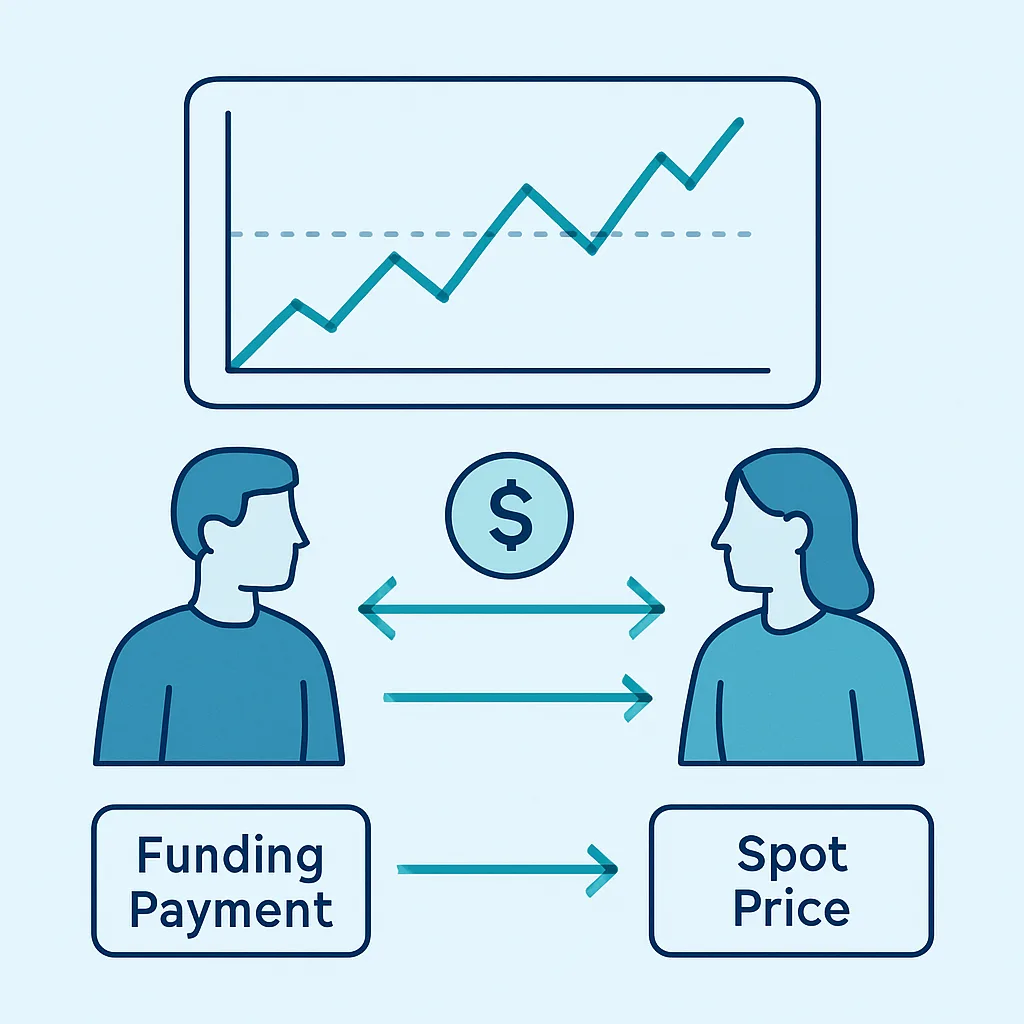
Perpetual futures let traders take long or short positions without an expiry date. Because these contracts do not settle on a fixed date, exchanges use periodic funding payments to help keep a contract’s price near the underlying asset’s spot price.
What is a funding fee?
A funding fee is a payment exchanged between traders holding opposing sides of a perpetual contract. Depending on the funding rate, traders with long positions may pay traders with short positions, or the reverse. It is generally a transfer between traders rather than a standard trading fee charged by the exchange, though an exchange may set the calculation rules and schedule.
How the funding rate works
The funding rate is the percentage used to calculate the payment. Its sign indicates which side pays: a positive rate commonly means longs pay shorts, while a negative rate commonly means shorts pay longs. Exact conventions, timing, and calculation methods can vary by platform, so check the contract’s details.
Funding rates often reflect the difference between the perpetual contract price and the spot price. If the contract trades above spot, a positive rate may encourage some traders to favor shorts and discourage crowded longs. If it trades below spot, a negative rate may encourage the opposite. Funding can also be influenced by platform-specific factors and market conditions; it does not guarantee that prices will converge.
A simple calculation
Suppose you hold a position with a notional value of $10,000 at a funding time, and the funding rate is 0.01%. The payment is approximately $1 ( $10,000 × 0.0001 ). At a positive rate, a long would commonly pay this amount and a short would commonly receive it. If the rate were negative, the direction would commonly reverse.
Notional value is the position’s market exposure, not necessarily the margin you deposited. For example, leverage can let a smaller amount of margin control a much larger notional position. That means a modest-looking rate can produce a meaningful payment relative to your margin.
When funding is paid
Funding is applied at scheduled intervals set by the exchange. Some platforms use intervals such as every eight hours, while others may use different schedules or adjust them. You typically pay or receive funding only if you hold the position at the relevant funding time, but the exact rules can differ. A rate shown before settlement may also change before the payment is calculated.
What funding means for your trade
Funding is separate from trading fees and from profit or loss caused by price movement. A position can gain from a favorable price move but still pay funding; it can also lose from price movement while receiving funding. Consider all of these effects when estimating a trade’s total cost.
- Check the current funding rate, its sign, and the time remaining until the next settlement.
- Read the exchange’s rules for rate calculation, payment timing, and position valuation.
- Estimate the payment using your position’s notional value, not just your margin balance.
- Remember that rates can change, and receiving funding does not make a risky position safe.
Key takeaway
Funding is a recurring payment between long and short perpetual futures traders, intended to help keep contract prices aligned with spot markets. Its direction and size can change, and the cost may add up while a position is open. Treat funding as one part of your trading costs, alongside trading fees, price risk, and leverage risk.