
How RSI and Moving Averages Predict Crypto Price Trends
Learn how to use RSI and moving averages to forecast cryptocurrency market movements.
Technical analysis is a crucial aspect of cryptocurrency trading, and understanding common chart indicators can greatly enhance your ability to forecast market movements. Two of the most widely-used indicators are the Relative Strength Index (RSI) and Moving Averages (MA). In this lesson, we will delve into these indicators, teaching you how to effectively use them to predict crypto price trends.
Understanding RSI
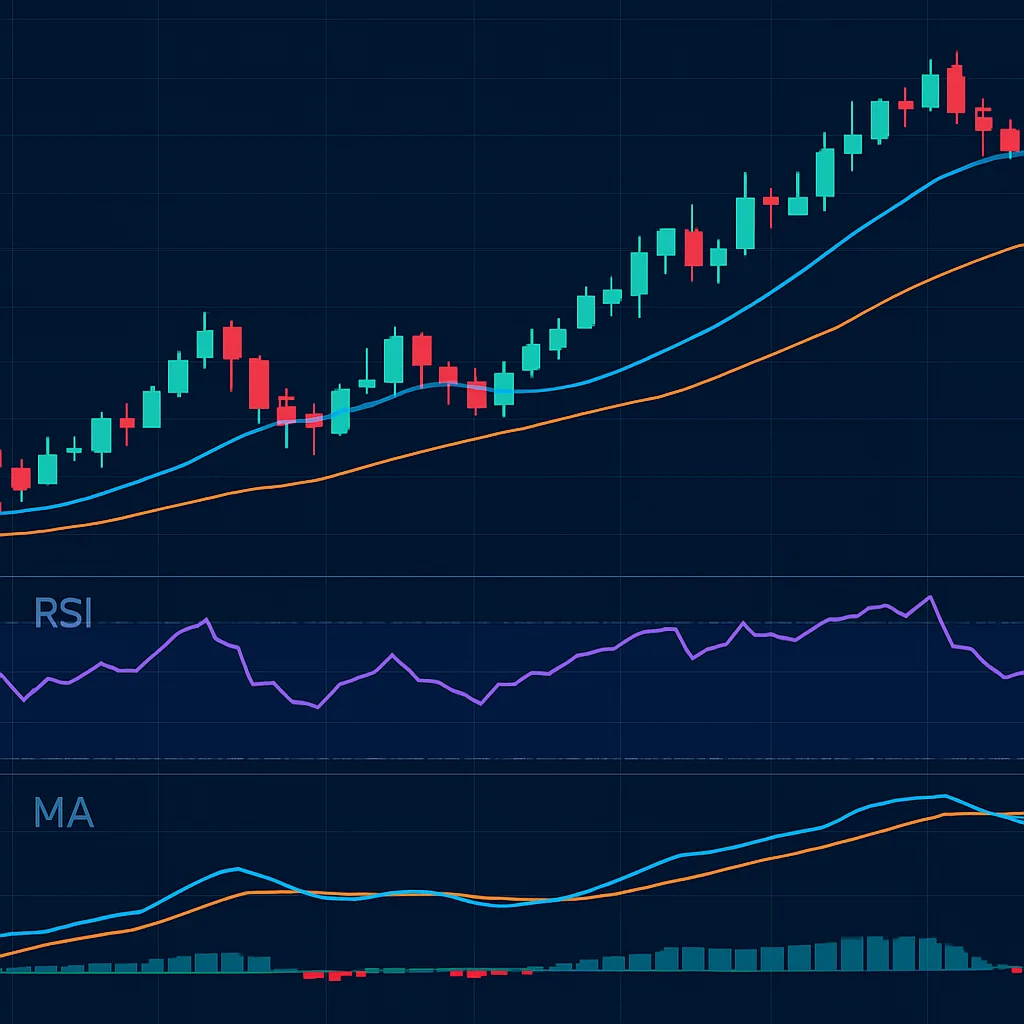
The Relative Strength Index (RSI) is a momentum oscillator that measures the speed and change of price movements. It ranges from 0 to 100, with readings above 70 indicating an overbought condition and readings below 30 indicating an oversold condition. Traders use the RSI to identify potential reversal points, making it a powerful tool for recognizing buy or sell opportunities.
Understanding Moving Averages
Moving Averages (MA) smooth out price data to create a single flowing line, which makes it easier to identify the direction of the trend. The two most common types of moving averages are the Simple Moving Average (SMA) and the Exponential Moving Average (EMA). While the SMA calculates the average price over a specific number of periods, the EMA gives more weight to recent prices, making it more responsive to new information.
Combining RSI and Moving Averages
Many traders use RSI and Moving Averages together to develop a more comprehensive view of the market. For example, when the RSI indicates an overbought condition and the price is above the moving average, traders might consider it a signal to sell. Conversely, if the RSI shows an oversold condition and the price is below the moving average, a buy signal could be inferred.
To apply these indicators effectively, it's important to consider the broader market context and combine them with other analytical techniques. Always remember that no indicator is foolproof and trading should involve a well-rounded strategy including risk management techniques.