
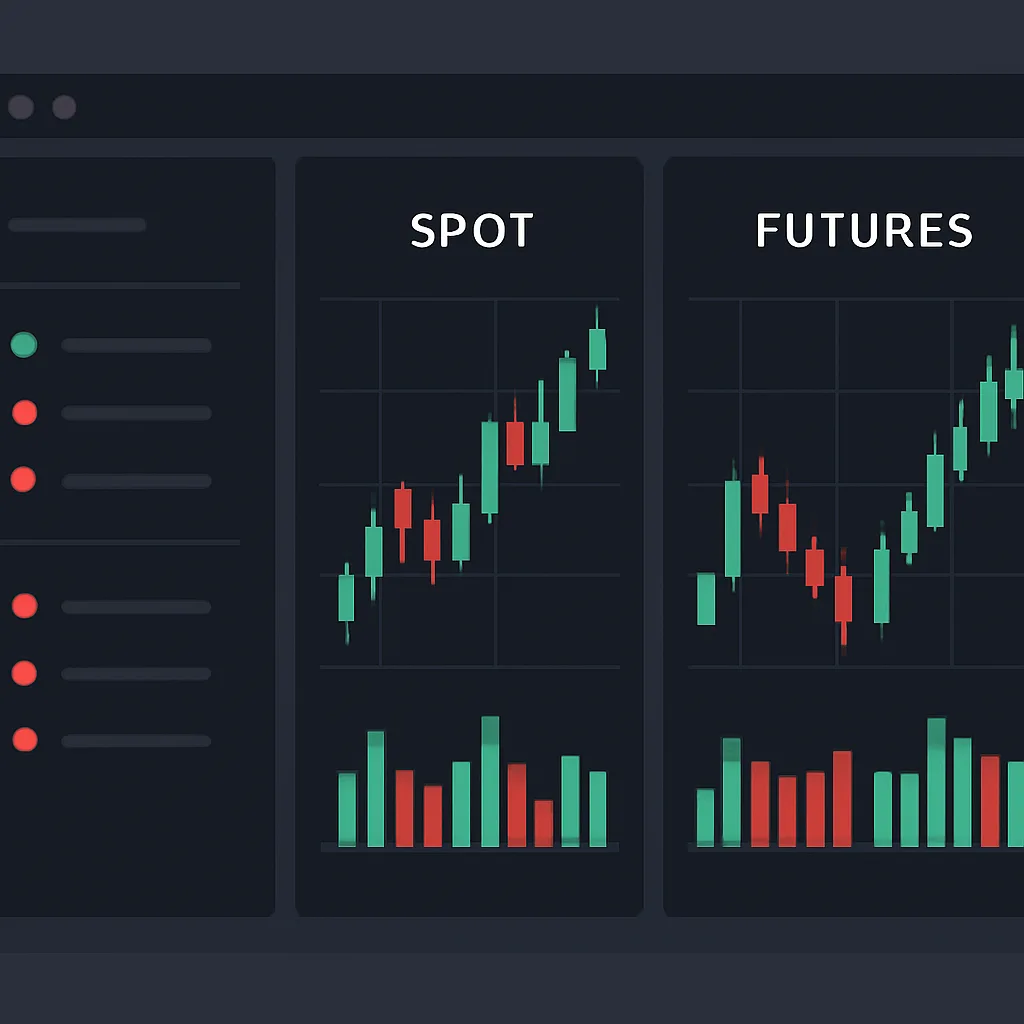
Spot or Futures? Build a Watchlist That Separates the Signals
A useful crypto watchlist does more than track prices. Pair spot markets with futures data to see demand, leverage, and risk in context.
A watchlist is most useful when it helps you answer a question, not just observe a list of prices. Tracking the same asset in spot and futures markets can reveal whether activity reflects direct buying and selling, leveraged positioning, or both.
Spot markets let traders buy or sell the underlying crypto asset. Futures contracts provide exposure to its price without requiring the same spot-market transaction, and may involve leverage, funding payments, and liquidation risk. These markets are related, but their prices and activity do not always tell the same story.
Start with the spot pair
Choose spot pairs that are relevant to your strategy and have enough liquidity for the size of trades you might place. For each pair, monitor price, trading volume, and the spread between the best available bid and ask. A large spread or thin volume can make execution less predictable, even when a chart looks active.
Note the quote asset as well. A BTC/USDT pair and a BTC/USDC pair both track Bitcoin against a stablecoin, but their liquidity and trading activity can differ by venue and market conditions. Compare the pair you actually intend to trade rather than assuming similar tickers behave identically.
Add the matching futures contract
Where available, add the futures contract for the same asset and compare its price with spot. Perpetual futures can trade at a premium or discount to spot, while funding payments help encourage the contract price to stay close to the underlying market. Funding is a useful context signal, but it is not a reliable prediction of what price will do next.
Track open interest alongside futures volume. Open interest represents the number of outstanding contracts, while volume shows how much trading occurred over a period. Rising open interest can indicate that positions are accumulating; it does not reveal by itself whether traders are net bullish or bearish, or whether a move is sustainable.
Build a compact, useful layout
A practical watchlist can group each asset’s spot pair and futures contract together. Consider including:
- Spot price and volume: A quick view of price movement and market participation.
- Spread or liquidity measure: Context for potential execution costs.
- Futures price versus spot: A view of the contract premium or discount.
- Funding rate: A snapshot of the cost or payment associated with holding a perpetual position.
- Open interest and futures volume: Indicators of contract activity, interpreted together rather than in isolation.
Use consistent time intervals when comparing these measures. A funding rate may be calculated over a particular period, while volume and price charts may show different intervals. Check the exchange’s contract details and data definitions before drawing conclusions.
Read combinations, not single indicators
If spot volume rises alongside price, that may show increased activity in the underlying market. If futures open interest also climbs, leveraged participation may be growing too. Neither combination guarantees continuation: traders can be opening positions in either direction, and market conditions can change quickly.
If futures move sharply while spot activity remains muted, investigate before treating the move as broad market demand. Contract-specific positioning, thin liquidity, or a short-lived surge in trading can affect futures prices. Conversely, strong spot activity with subdued futures metrics may suggest that the move is less dependent on derivatives positioning—but it still does not remove market risk.
Keep the list manageable and review it
Start with a small number of assets you understand and can monitor. Remove pairs that are consistently illiquid or no longer relevant to your plan. Set alerts for meaningful changes in price, volume, funding, or open interest rather than reacting to every fluctuation.
A spot-and-futures watchlist is a decision aid, not a trading signal. Use it to compare market activity, check liquidity, and spot where leverage may be affecting price behavior. Before placing a trade, confirm the contract specifications, fees, and risks—and decide in advance how much you can afford to lose.