
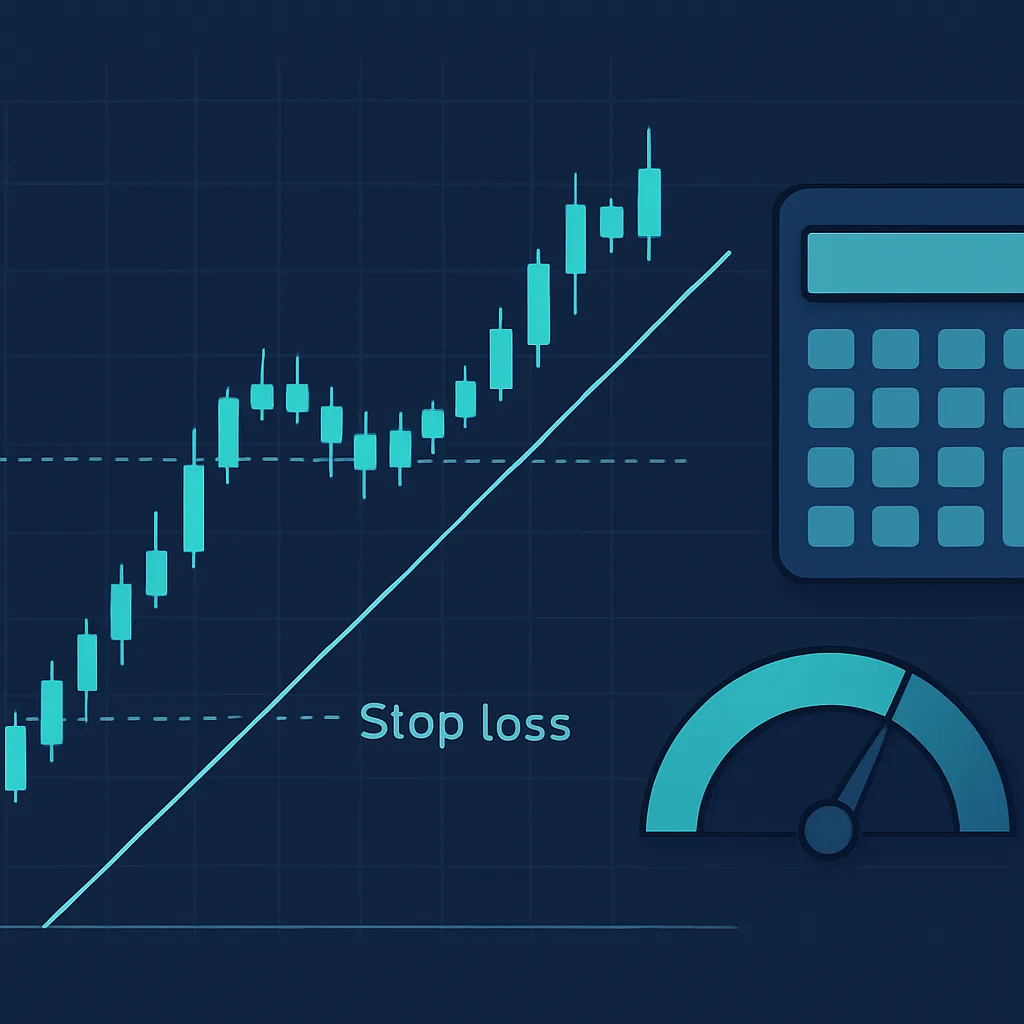
How to Calculate Crypto Position Size From Your Risk Limit
Learn how to turn a chosen account risk percentage and stop-loss distance into a position size, with worked examples and practical cautions.
Position sizing connects your trading plan to a measurable potential loss. Instead of choosing a trade size by instinct, you first decide how much of your account you are willing to lose if the stop-loss is reached. You then calculate the position size that fits that limit.
1. Choose a risk percentage
Set a maximum risk per trade as a percentage of your account equity. For example, if your account is worth $5,000 and you choose to risk 0.5%, your planned risk is:
$5,000 × 0.005 = $25
The percentage is a planning choice, not a guarantee. Several losing trades in a row can reduce your balance, so consider your overall exposure and ability to absorb losses.
2. Find the stop-loss distance
For a long position, subtract the stop price from the planned entry price. For a short position, subtract the entry price from the stop price. Use the absolute difference so the distance is positive.
Stop distance per unit = |entry price − stop price|
For a long trade with an entry at $50,000 and a stop at $49,000, the distance is $1,000 per BTC, or 2% of the entry price.
3. Calculate the position size
When prices and quantities are expressed in the same quote currency, use:
Position size in units = planned risk ÷ stop distance per unit
In the example, $25 ÷ $1,000 = 0.025 BTC. At an entry price of $50,000, that position has a notional value of $1,250. If the stop is triggered at $49,000, the price loss is approximately $25 before fees, slippage, and funding.
Use the percentage form when helpful
You can also calculate notional position value directly when the stop distance is expressed as a percentage of entry:
Position value = planned risk ÷ stop-distance percentage
With $25 of planned risk and a 2% stop distance, the position value is $25 ÷ 0.02 = $1,250. Divide that value by the entry price to get the quantity: $1,250 ÷ $50,000 = 0.025 BTC.
Account for practical trading costs
The calculation estimates loss from the entry-to-stop price move; it does not ensure the final loss will stay within the chosen amount. Trading fees, spread, slippage, and—on perpetual futures—funding can add costs. In fast or illiquid markets, a stop may fill at a worse price than requested. To leave room for these uncertainties, some traders use a slightly smaller position than the formula allows.
Check the exchange’s contract specifications before placing an order. Minimum order sizes, quantity increments, and contract multipliers may require rounding. Round down rather than up if rounding up would exceed your risk limit.
Leverage does not change the planned price risk
Leverage reduces the margin required to open a given position, but it does not reduce the loss caused by a given position size and price move. A $1,250 position with a 2% adverse move still loses about $25 before costs, whether it is opened with spot funds or with leverage. Leverage can also increase liquidation risk, so check liquidation price and margin requirements separately.
Quick checklist
- Calculate account equity and apply your chosen risk percentage.
- Set a stop based on the trade plan, not on the position size you want.
- Measure the entry-to-stop distance and calculate quantity or notional value.
- Allow for fees, slippage, funding, and contract rules.
- Recalculate after changing the entry, stop, account balance, or risk limit.
Fixed-risk position sizing is a planning tool, not a promise of a fixed maximum loss. Stops can execute imperfectly, and crypto markets can move sharply. Use a size you can afford to lose and review your risk across all open positions.