
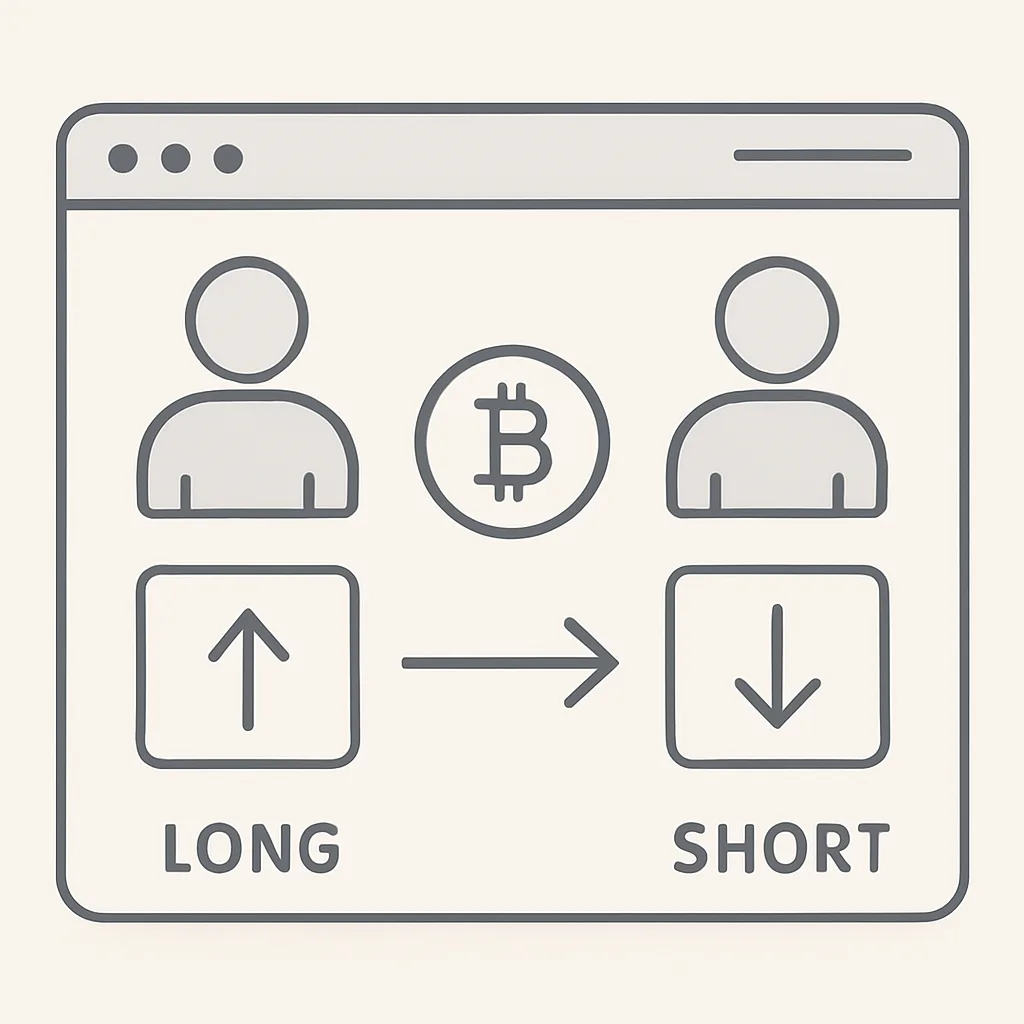
How Perpetual Futures Funding Payments Work
Learn why funding payments exist, how rates determine who pays, and how funding can affect the cost of holding a perpetual futures position.
Perpetual futures are contracts with no expiry date. Because they do not settle on a fixed date, exchanges use periodic funding payments to help keep a contract’s price close to the underlying market price.
What is a funding payment?
Funding is a payment exchanged between traders holding long and short positions. It is generally not a fee paid to the exchange, though the exact rules depend on the platform. The funding rate determines which side pays and how much.
How the funding rate works
When a perpetual contract trades above its reference spot price, its rate is often positive. In that case, traders with long positions typically pay traders with short positions. When the contract trades below the reference price, the rate may be negative, and shorts typically pay longs. Rate conventions and payment rules vary, so check the contract details on your platform.
Funding rates can change over time as market conditions shift. A positive rate does not mean it will stay positive, and a negative rate does not guarantee it will remain negative.
A simple example
Suppose a platform shows a positive funding rate for a contract. If you hold a long position at the funding time, you may owe a payment based on your position’s value and the stated rate. A short position may receive the corresponding payment. If the rate is negative, the usual direction reverses.
For illustration, if a position is valued at 1,000 USDT and the applicable rate is 0.01%, the payment would be about 0.10 USDT, before considering platform-specific calculation rules. This example is not a forecast or a guaranteed amount.
When funding is charged
Each contract has its own funding schedule. Payments may occur at set intervals, and a position’s eligibility can depend on whether it is open at the funding timestamp. Check the contract page for the interval, rate, calculation method, and settlement rules. Do not assume every platform uses the same schedule.
Why funding matters to your position
Funding can add to or subtract from the cost of holding a perpetual position. If you hold a position across several funding times, repeated payments may affect your overall result. Funding is separate from trading fees and any profit or loss caused by price movement.
A position can lose money even if funding is favorable, because price changes may outweigh received payments. Likewise, an unfavorable funding payment does not by itself determine whether a trade is profitable.
What to check before holding a position
- Check the current funding rate and whether it is positive or negative.
- Confirm the next funding time and how the platform determines eligibility.
- Review whether the displayed rate is estimated or final.
- Consider how long you expect to hold the position and how rates could change.
- Include funding alongside trading fees, leverage, and possible price losses when assessing risk.
Funding rates are variable, and perpetual futures use leverage that can magnify losses and lead to liquidation. Understand the contract rules before trading, and never treat a funding payment as guaranteed income.