
How Order Types Control Price and Execution on Crypto Exchanges
Learn how market and limit orders differ in execution, price control, and trade-offs—and how to choose between them.
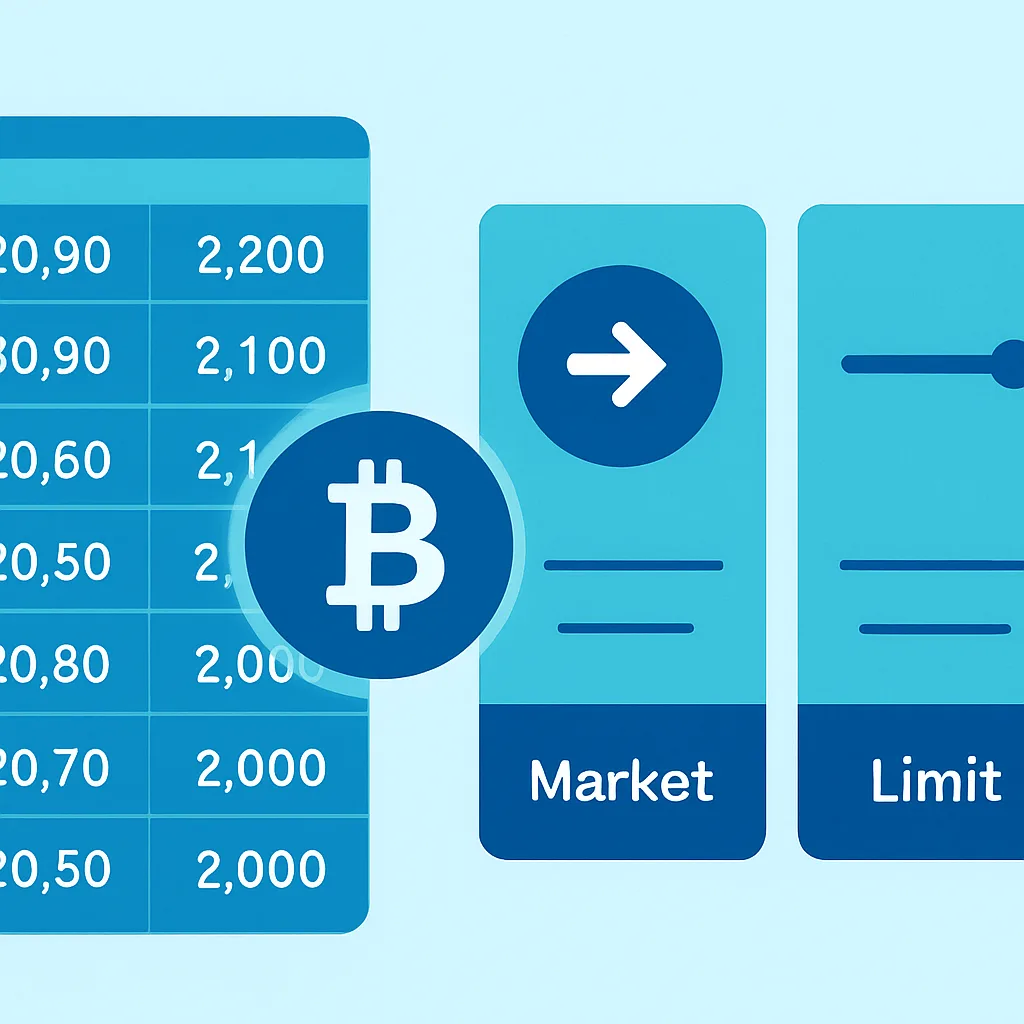
When you trade crypto, the order type you choose affects how your trade executes. A market order prioritizes speed, while a limit order sets a price boundary. Neither guarantees both immediate execution and a specific price.
What is a market order?
A market order asks the exchange to buy or sell immediately against available orders on the order book. It generally offers a higher chance of quick execution, but the final price can differ from the price you saw when submitting it. This is especially relevant when prices are moving quickly or the market is thin.
A large market order may fill across several price levels. For example, if you buy more BTC than is available at the best ask, the remaining portion may execute at higher asks. This effect is called slippage. Check the exchange’s estimated cost and available liquidity before confirming a sizable order.
What is a limit order?
A limit order sets the worst price you are willing to accept. A buy limit can execute at its limit price or lower; a sell limit can execute at its limit price or higher. The order may fill immediately if it crosses the available opposite-side prices, or it may rest on the order book until a matching counterparty appears.
A limit price does not guarantee execution. The market may never reach it, or other orders at the same price may be ahead of yours. An order can also fill only partially, leaving the remainder open unless you cancel it or the exchange applies a time-in-force rule.
Key differences at a glance
- Execution priority: Market orders prioritize taking available liquidity; limit orders prioritize enforcing a price boundary.
- Price certainty: A market order has no guaranteed execution price. A limit order sets a price limit but does not guarantee a fill.
- Timing: Market orders usually execute promptly when liquidity is available. Limit orders may wait, fill partially, or remain unfilled.
- Fees: Fees depend on the exchange’s fee schedule and how the order interacts with its book. Do not assume a limit order always receives a maker fee or a market order always has a particular fee; check the applicable terms.
When might each order type make sense?
A market order may suit a trade where prompt execution matters more than controlling the exact entry or exit price. Before placing one, review the spread, order-book depth, order size, and any price-impact estimate shown by the exchange.
A limit order may suit a trade where you want to cap the buy price or set a minimum sale price. Choose a limit that reflects your plan, then consider how long you are willing to wait and what you will do if the order remains open. Avoid choosing a price solely because it looks attractive if a fill is important to your strategy.
Before you submit an order
- Confirm the trading pair and whether you are buying or selling.
- Review the current bid, ask, spread, and visible order-book depth.
- Check the quantity, estimated total, fees, and any slippage warning.
- For a limit order, verify the limit price and whether the order will rest or execute immediately.
- After submission, check the order status. Cancel or adjust an open order only if that still fits your plan.
Order-type availability, fee treatment, and execution rules can vary by exchange and market. Read the current platform terms before trading. Crypto prices can move sharply, and either order type can result in an unfavorable outcome; use order sizes and risk limits you can afford.