
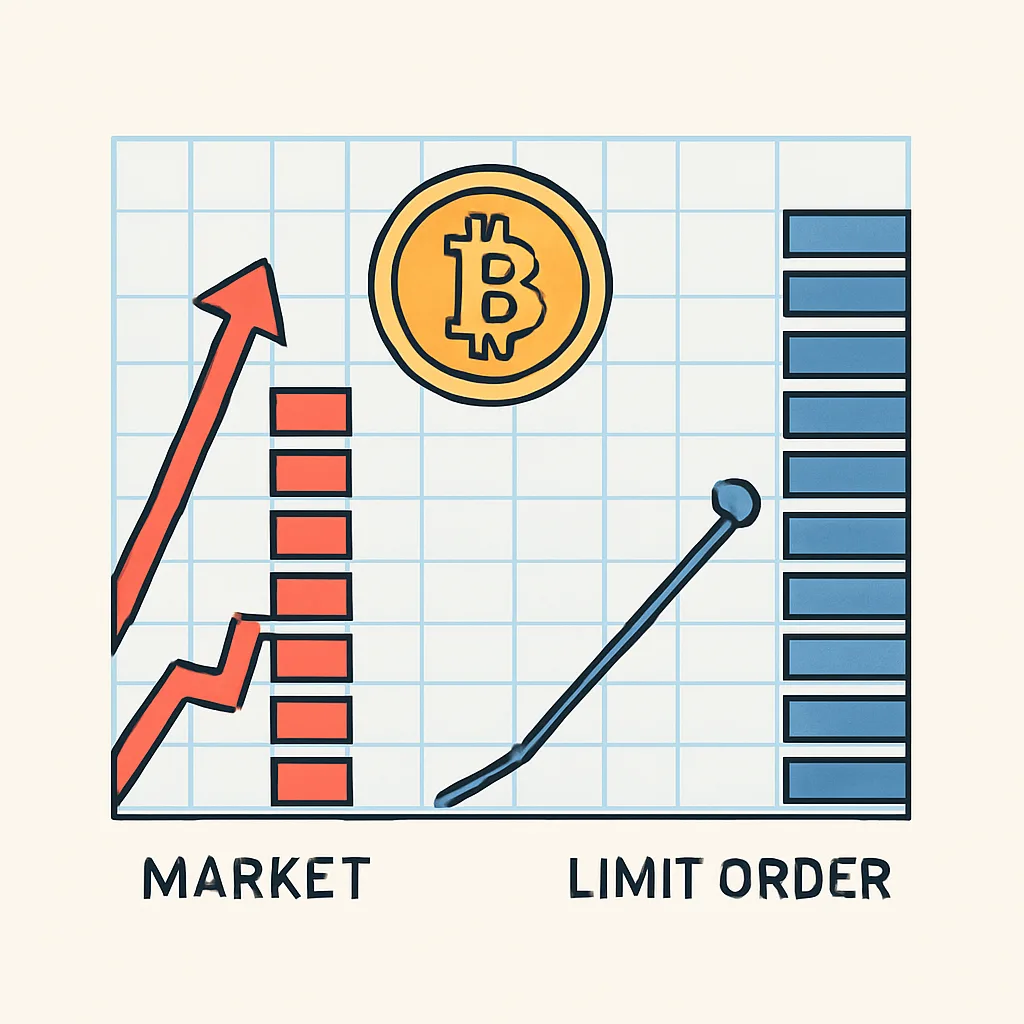
Limit Orders and Market Orders: Price Control vs Speed
Compare the certainty of execution offered by market orders with the price control of limit orders, and learn how liquidity, volatility, and order-book depth can affect each choice.
When you place a trade on a crypto exchange, your order type helps determine how it interacts with the order book. A market order prioritizes execution at available prices. A limit order sets the price you are willing to accept, but may not execute. Neither type guarantees both a specific price and an immediate fill.
What is a market order?
A market order tells the exchange to buy or sell immediately against available orders on the opposite side of the order book. A market buy matches with sell orders; a market sell matches with buy orders. The exchange typically fills the order across one or more price levels until the requested quantity is filled or available liquidity runs out.
The displayed last-traded price is not a promise of the price you will receive. If the best available quantity is smaller than your order, the remaining amount may fill at progressively less favorable prices. This difference between the expected and actual average execution price is called slippage. Market orders can also incur taker fees, depending on the exchange’s fee schedule and how the order is matched.
What is a limit order?
A limit order specifies the worst price you are willing to accept. A buy limit sets a maximum purchase price; a sell limit sets a minimum sale price. For example, if an asset is trading near 100 USDT, a buy limit at 98 USDT will not execute above 98 USDT. It may execute at 98 or better if eligible sell orders reach it, but it can remain unfilled if the market does not.
A limit order can provide price control, not execution certainty. Even if the market touches your limit, your order may not fill: other orders at the same price may be ahead in the queue, or the available quantity may be insufficient. A limit order that immediately matches existing orders can be treated as a taker order. An order that rests in the book may be treated as a maker order, subject to the exchange’s rules.
Key differences at a glance
- Execution: Market orders generally seek prompt execution at available prices; limit orders execute only at the specified price or better and may remain open.
- Price control: Market orders do not set a maximum buy price or minimum sell price. Limit orders do.
- Slippage: Market orders can sweep multiple price levels, especially when liquidity is thin or the order is large. A limit order protects its price boundary but does not guarantee a fill.
- Fees: Fees depend on whether a trade is classified as maker or taker under the exchange’s rules, not simply on whether you selected a limit or market order.
- Use case: Market orders can suit situations where prompt execution matters more than exact price. Limit orders can suit situations where sticking to a price threshold matters more than getting filled immediately.
How to choose between them
Before placing an order, check the bid-ask spread, visible order-book depth, and the size of your trade relative to available liquidity. A wide spread or shallow book can make a market order more costly than the quoted price suggests. Fast-moving markets can change before an order reaches the book, so estimates are not guarantees.
Consider a market order when you need to enter or exit promptly and understand that the final average price may differ from the price currently displayed. Consider a limit order when you have a clear price boundary and can accept that the trade might not happen. For large trades, breaking an order into smaller portions may reduce the impact on the book, though it does not eliminate execution risk or guarantee a better result.
Practical checks before submitting
- Confirm the trading pair and whether you are buying or selling.
- Review the order quantity and the exchange’s estimated total or proceeds.
- For a market order, inspect the spread and nearby depth; check whether the exchange offers a slippage limit or equivalent protection.
- For a limit order, verify the limit price, time-in-force setting, and whether any unfilled quantity can be canceled or remain open.
- Review fees and remember that an order can fill in parts at different times or prices.
Order types are execution tools, not profit guarantees. Choose based on your priorities, confirm the details on the exchange before submitting, and never assume a limit order will fill or a market order will execute at the last-traded price. Exchange interfaces and policies can change; verify current order and fee rules before trading.